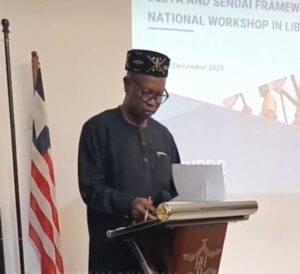
(December 16, 2025):
Ladies and Gentlemen
On behalf of the National Disaster Management Agency and the Government of Liberia, I am honored to deliver these remarks at this Delta and Sandai Framework Monitoring National Workshop held here, at the Royal Grand Hotel, in Monrovia.
This workshop arrives at a crucial moment for Liberia and climate-vulnerable countries worldwide. Climate change is no longer a distant threat or a future concern. It is a tangible reality that is transforming lives, disrupting livelihoods, damaging ecosystems, and undoing development progress, especially affecting women, youth, smallholder farmers, and frontline communities.
For the National Disaster Management Agency, these impacts are not theoretical. They are visible in the communities we serve and the emergencies we respond to. Floods displace families and wash away homes. Extreme rainfall damages roads, schools, and markets. Prolonged dry spells weaken food systems and threaten nutrition. Slow climate processes quietly but relentlessly erode resilience, dignity, and hope.
These realities are what the global community now recognizes as Loss and Damage.
Loss and damage refer to climate impacts that exceed the limits of adaptation. It includes economic losses such as destroyed infrastructure, farms, livelihoods, and public services. It also includes non-economic losses that are equally profound, including loss of life, cultural heritage, ecosystems, traditional knowledge, social cohesion, and human dignity.
For Liberia, “Loss and Damage” is not simply an international negotiation agenda. It is a national development challenge. It is a governance issue. And above all, it is a question of justice.
This is why Loss and Damage sits at the heart of Liberia’s ARREST Agenda, particularly its commitments to resilience, social protection, food security, and inclusive growth.
Climate shocks threaten to reverse years of hard won progress unless they are addressed through deliberate prevention, preparedness, and fair and accessible climate finance.
Yet recognition alone is not enough.
Justice requires evidence. And evidence depends on strong, credible, and people centered data systems.
The Sendai Framework for Disaster Risk Reduction reminds us that understanding disaster risk is the foundation of resilience. It calls for systematic data collection, analysis, and use to reduce losses to lives, livelihoods, and infrastructure. In this regard, the National Disaster Management Agency places data at the very center of climate justice.
Frameworks such as the DELTA Resilience system provide structured approaches for tracking disaster impacts, losses, and damages across sectors and over time.
By harmonizing methodologies and reporting standards, these systems enable us to translate community-level experiences into nationally owned and internationally credible evidence. Similarly, UNDP supported data initiatives that reinforce the importance of aligned national protocols for capturing both economic and non-economic losses. These systems allow us to understand Loss and Damage not as isolated events, but as cumulative shocks that weaken fiscal stability, deepen inequality, and constrain long-term development.
For action and aid in our core constituencies – women, youth, and smallholder farmers , this evidence is transformative.
It strengthens advocacy for climate justice. It supports fair access to Loss and Damage finance and it ensures that investments in agroecology, renewable energy, and community led solutions are grounded in real needs and lived realities.
Women and young people are not only victims of climate impacts. They are leaders of resilience and innovation. Agroecology strengthens food systems under climate stress, while renewable energy expands opportunity, reduces vulnerability, and supports just transitions.
These pathways must be guided by data that tell us who is affected, how they are affected, and which solutions truly work.
Partners and distinguished colleagues, the credibility of the Loss and Damage agenda will not be measured by the strength of our declarations, but by the effectiveness of our systems and the fairness of our collective outcomes.
From the standpoint of the National Disaster Management Agency, three priorities are essential.
First, we must invest in national and community level Loss and Damage data systems that capture real impacts where they occur, including gender responsive and youth inclusive data.
Second, we must strengthen institutional and local capacities so that data collection, early warning, and reporting are inclusive, consistent, and sustainable.
Third, we must ensure that Loss and Damage financing is allocated transparently, guided by evidence, equity, and the principles of climate justice.
Liberia stands ready to work with, civil society, development partners, and communities to strengthen these systems and align disaster risk management with climate justice, agroecology, and a just energy transition.
Finally, Loss and Damage is not only about climate impacts. It is about people. It is about protecting livelihoods, preserving culture, empowering women and youth, and safeguarding our shared future. By strengthening data systems, we give voice to affected communities, credibility to national claims, and direction to global action. This is how we transform climate justice from principle into practice.
Thank you.